Skip to content

YÖK Micro-credentials Framework · Open Badges 3.0

Your certificate is now verifiable.

Verifiable digital badges, a digital wallet and single-address verification for universities.

W3C Verifiable Credentials · ES256 signatures · KVKK: data stays in Türkiye

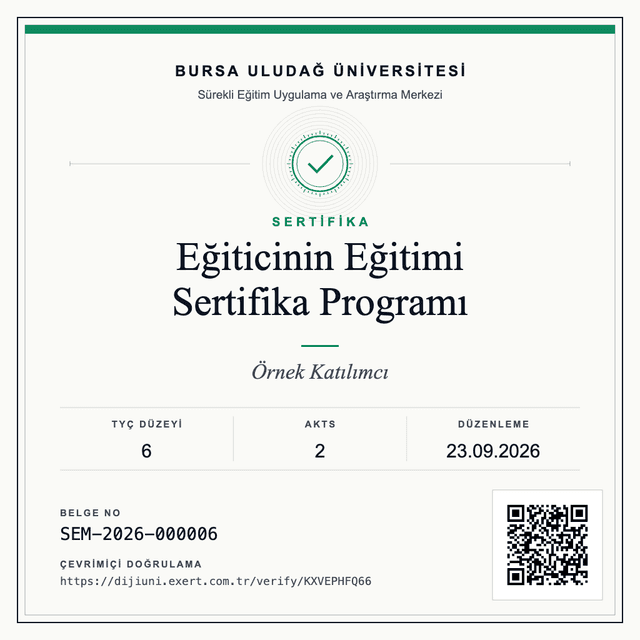
Sample badge rendered from the Micro-credential Badge template: Train-the-Trainer Certificate Programme, SEM-2026-000006

Credential

Valid

Bursa Uludağ Üniversitesi · Sürekli Eğitim Uygulama ve Araştırma Merkezi

Eğiticinin Eğitimi Sertifika Programı

ECTS
2
Level
TQF 6
Valid from
23 Sept 2026
Valid until
23 Sept 2031
Document no.
SEM-2026-000006

Signing key: kid: did:web:dijiuni.com:issuers:uludag#key-1
A verification result taken from the live system. The participant name is replaced with a sample.

Verify a badge in five seconds

Verify with a file (PNG, SVG, PDF, JSON)
  • Open Badges 3.0
  • W3C VC 2.0
  • Bitstring Status List
  • did:web

How it works

From programme definition to verifiable evidence

  1. 01Annex 1 · TQF 5–8 · ECTS calculation

    Programme definition

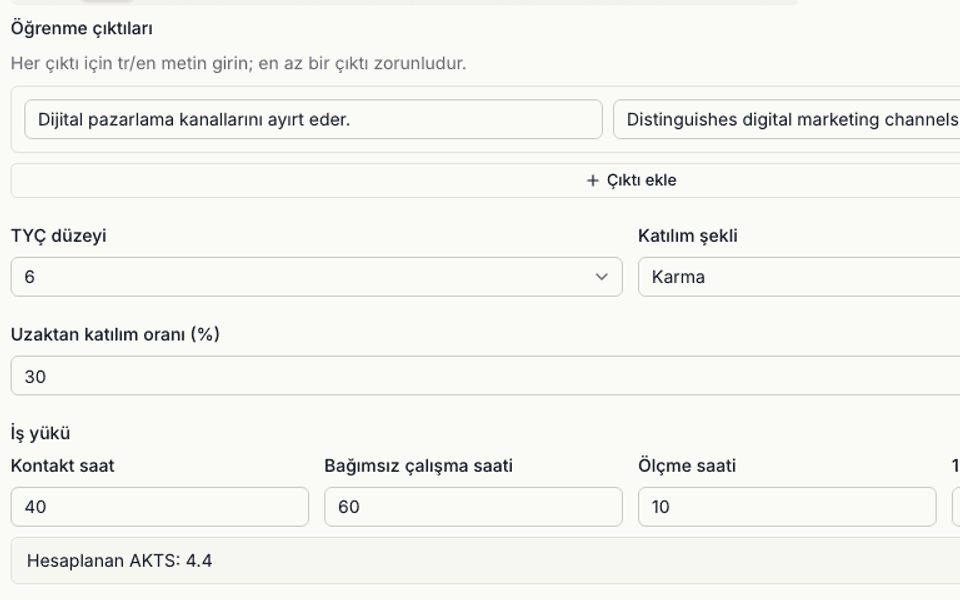
    The 11 minimum fields of Annex 1 are part of the programme record: learning outcomes, ECTS, TQF level, assessment method, mode of participation, success criteria and quality assurance.

    Annex 1 tab on the programme screen
  2. 02Approval chain · Document no · Badge + Certificate

    Issuance and signature

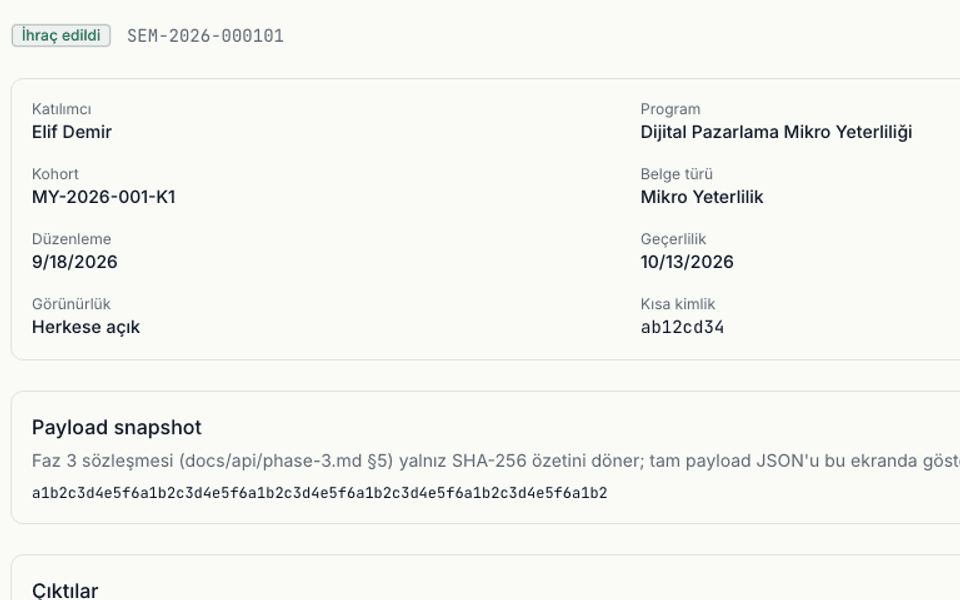
    Each request passes an approval chain that takes the printed name/title from the people who actually approve it, receives a document number and is signed with ES256. The badge image and the certificate PDF are generated together from the same signed record.

    Issue request detail with approval chain
  3. 03LinkedIn · QR · e-Devlet lookup

    Wallet and verification

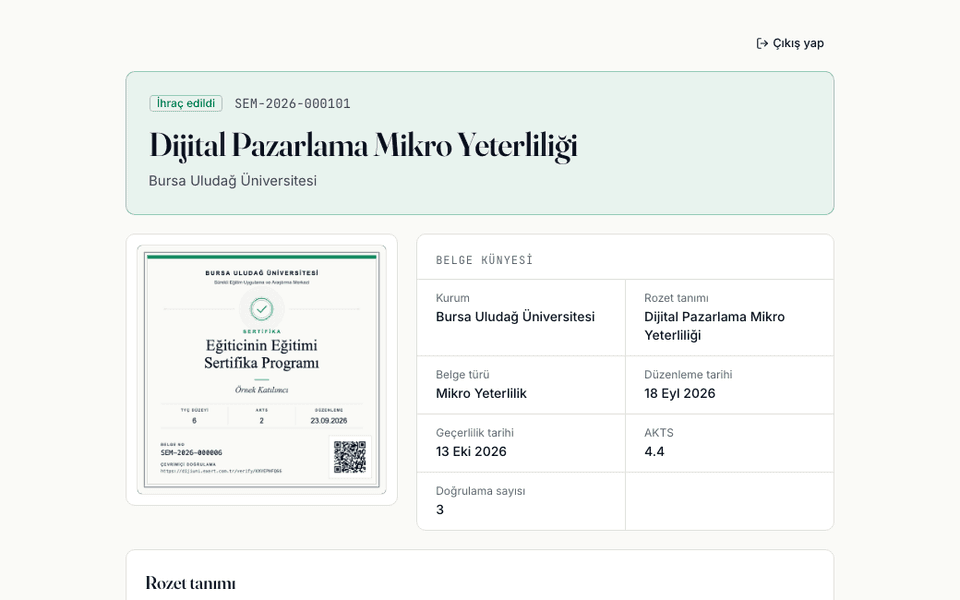
    Learners keep the document in their wallet, add it to LinkedIn and share it by QR or time-limited link. Verifiers see the result at one address.

    Badge detail and sharing in the digital wallet

Why DijiUni?

Today's problem, and DijiUni's answer

Read the full study
  1. 01 · TodayA printed certificate can easily be copied, and telling a forgery from the genuine article is often impossible.

    With DijiUniEvery badge carries the issuing institution's electronic signature, so even the smallest change to the document is detected immediately during verification.

  2. 02 · TodayAn employer wishing to confirm a certificate must correspond separately with the university that issued it.

    With DijiUniEntering the verification code on the certificate is sufficient; the result appears within seconds, with no further correspondence required.

  3. 03 · TodayReissuing a lost certificate involves a written application, a waiting period and often an additional fee.

    With DijiUniThe badge is stored permanently in the holder's digital wallet and can be downloaded or shared again whenever the holder wishes.

YÖK compliance

The fields the regulation asks for, inside the badge's own data

The regulation on continuing-education certificate programmes, in force from 1 October 2026, and YÖK's Procedures and Principles for the Micro-credentials Framework require the document to carry the 11 minimum items in Annex 1 and to be issued as a verifiable, internationally compatible badge in a digital wallet.

DijiUni keeps these fields as the data structure of the signed badge rather than as a separate form printout. The mapping alongside is taken from the JSON-LD of every issued badge.

Annex 1 minimum fields and their Open Badges 3.0 JSON-LD locations
#Annex 1 field
01Learner identitycredentialSubject.identifier[]sha256$…
02Name of the trainingachievement.namedijiuni:localizedName
03Issuing institutionissuerdijiuni:issuingUnit
04Date of the certificatevalidFromawardedDate
05Learning outcomesdijiuni:learningOutcomes[]
06Workload (ECTS)achievement.creditsAvailabledijiuni:workloadHours
07Level (TQF)dijiuni:tycLevelalignment · TYC-n
08Assessment type and methodresultDescription[]dijiuni:assessment
09Mode of participationdijiuni:participationMode
10Success criteriaachievement.criteria.narrative
11Quality assurancedijiuni:qualityAssurancedijiuni:yokApprovalNo

Who it is for

Three parties, one record

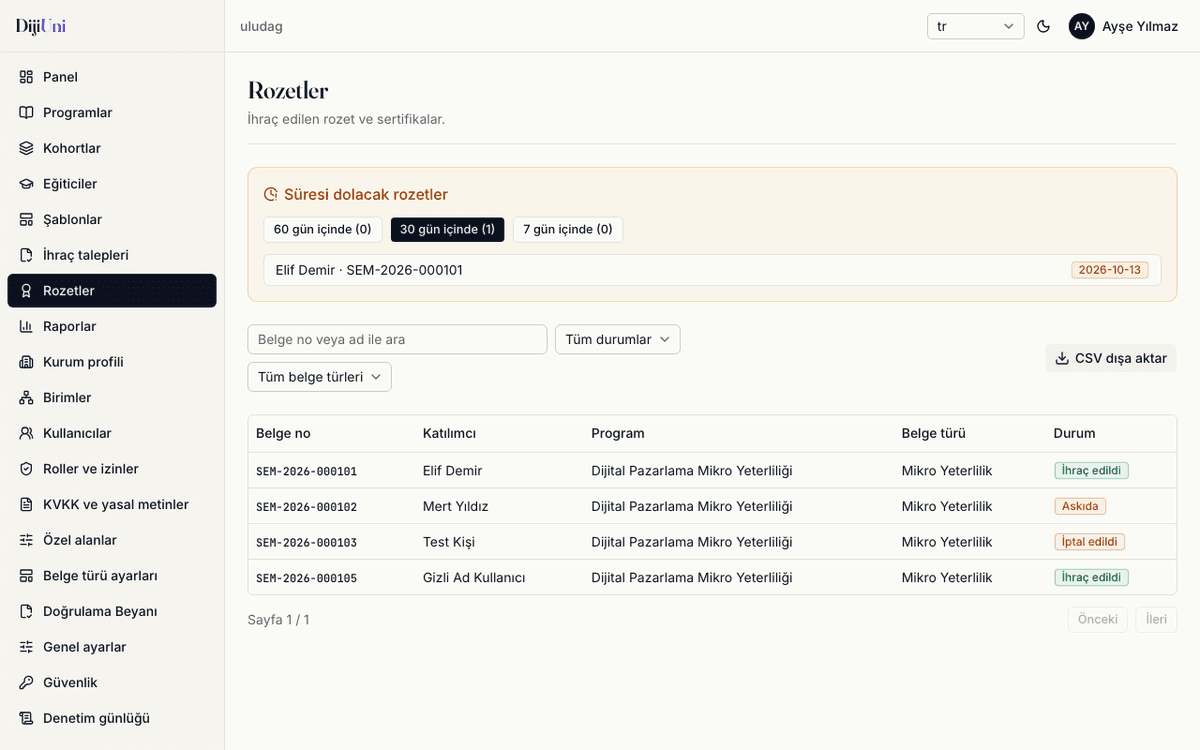
One panel for continuing and distance education operations.

Institution panel: reports screen
  • Programme, cohort, participant and assessment records
  • YÖKSİS application package and participant export file
  • Unit-level approval and signature chain
  • Issuance, revocation and verification reports
Institution sign-in

Standards and security

Open standards, auditable signatures

Open Badges 3.0 and W3C VC 2.0
Every badge is a VC-JWT; any compatible verifier can read it without depending on DijiUni.
did:web and key rotation
Institution keys are published in a did:web document. Retired keys keep verifying past badges; revoked keys are removed.
Bitstring Status List
Revocation and suspension are read from a compressed bit list that carries no personal data.
KVKK, hosting in Türkiye and account security
The learner's name is not written into the badge by default; identity travels as a salted hash. Data is hosted in Türkiye, backed up encrypted on a regular schedule; accounts are temporarily locked after repeated failed logins, and an isolation layer keeps one institution's data from leaking into another's.
WCAG 2.2 AA
The verification portal and the wallet are fully usable with keyboard and screen readers.
CLR 2.0 learner record
Multiple badges are bundled into a single signed learning portfolio (Comprehensive Learner Record) and attached to the recognition package; each badge keeps its own signature.
vc+jwt · ES256SEM-2026-000006
// header
{
  "alg": "ES256",
  "typ": "vc+jwt",
  "cty": "vc",
  "kid": "did:web:dijiuni.com:issuers:uludag#key-1"
}

// claims
{
  "iss": "https://dijiuni.com/issuers/uludag",
  "nbf": 1790158814,
  "exp": 1947888000,
  "type": [
    "VerifiableCredential",
    "OpenBadgeCredential"
  ],
  "credentialSubject": {
    "creditsEarned": 2,
    "achievement": {
      "achievementType": "Certificate",
      "name": "Eğiticinin Eğitimi Sertifika Programı",
      "dijiuni:tycLevel": 6
    }
  },
  "credentialStatus": [
    {
      "type": "BitstringStatusListEntry",
      "statusPurpose": "revocation",
      "statusListIndex": "21397"
    }
  ],
  "dijiuni:documentNo": "SEM-2026-000006"
}
VC-JWT header and claims of a badge in the live system (abridged)

Resources

Guides to regulation, standards and verification

Articles that explain the YÖK rules, the Open Badges 3.0 standard and document verification, with sources.

  1. The YÖK Micro-credentials Framework: a summary of the Procedures and Principles and what it means for universities

    Summary of Turkey's YÖK micro-credentials rules: definitions, the 11 Annex 1 fields, the 10% ECTS and 50% online limits, and the digital wallet duty.

  2. 1 October 2026: YÖK approval and e-Devlet verification for continuing education certificate programmes

    From 1 October 2026, university continuing education (SEM) certificate programmes need YÖK approval via YÖKSİS: process, roles and e-Devlet.

  3. What is a digital badge? Open Badges 3.0 and verifiable certificates

    A digital badge is a document signed by its issuer that can be verified at any time. Open Badges 3.0, W3C VC 2.0, did:web and status lists explained.

  4. How do you verify that a certificate is genuine? By code, QR code and file

    How to check that a university certificate or digital badge is genuine, unmodified and still valid using its short code, QR code or file.

  5. The digital wallet: storing, sharing and adding your certificates to LinkedIn

    Receiving a badge in the digital wallet, visibility settings, sharing by link and QR code, adding it to LinkedIn, downloads and recognition packages.

  6. The fake certificate problem and verifiable document infrastructure for institutions

    Why fake certificates are easy to produce, why verification by correspondence falls short, and the components of a verifiable document infrastructure.